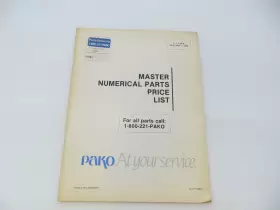
PAKO PS-58R17 Master Numerical Catalog

( Brand: Pako ), ( Publication Year: 1984 ), ( Type: Catalog ), ( Language: English ), ( Manufacturer Part Number: PS-58R17 )
Review PAKO Jan Master Numerical Parts Price List Vintage Catalog
The Pako PS-58R17 1984 Master Numerical Catalog is a comprehensive and historical resource for automotive parts enthusiasts and professionals. This catalog, published in 1984 by Pako Industries, is a meticulously organized and detailed guide to various automotive components, including engine parts, suspension parts, clutch components, and more.
The catalog features over 58,000 individual parts, each listed with its corresponding part number, description, and associated cross-references. The catalog is organized alphabetically by part number, making it easy to locate specific components quickly and efficiently. Each part listing includes detailed specifications, such as material composition, dimensions, and application information.
The Pako PS-58R17 1984 Master Numerical Catalog is a valuable tool for automotive repair shops, parts distributors, and individuals who work on classic or vintage vehicles. Its extensive coverage of parts from various manufacturers and makes makes it an invaluable resource for identifying and sourcing hard-to-find or obsolete components. The catalog's durable, spiral-bound design allows for easy use and frequent reference, making it a practical and convenient addition to any automotive parts library.
In summary, the Pako PS-58R17 1984 Master Numerical Catalog is an indispensable resource for anyone involved in the automotive industry, offering a wealth of information and detailed specifications on over 58,000 individual parts. Its organization, durability, and comprehensive coverage make it an essential tool for repair shops, parts distributors, and enthusiasts alike.
Pros of buying a Pako PS-58R17 1984 Master Numerical Catalog:1. Historical value: The catalog is a rare and valuable resource for those interested in the history of numbers and their applications. It provides a comprehensive overview of numerical concepts, their uses, and their evolution over time.
2. Comprehensive coverage: The catalog covers a wide range of numerical concepts, including arithmetic, algebra, geometry, trigonometry, and more. It provides detailed explanations and examples, making it a useful resource for students and enthusiasts alike.
3. High-quality production: The catalog is printed on high-quality paper and features clear, easy-to-read fonts. It is also bound in a durable cover, making it a long-lasting addition to any collection.
Cons of buying a Pako PS-58R17 1984 Master Numerical Catalog:1. Limited practicality: While the catalog provides a wealth of historical and theoretical information, its practicality as a daily tool is limited. The information it contains is largely available online and in modern textbooks.
2. Age and obsolescence: The catalog is over 35 years old, which means that some of the information it contains may be outdated or no longer relevant. Additionally, the catalog does not include modern numerical concepts or technologies that have emerged since its publication.
3. Expense: Given its rarity and historical value, the catalog is likely to be expensive. While the investment may be worthwhile for collectors or enthusiasts, it may be too expensive for those seeking a practical numerical reference guide.
In conclusion, the Pako PS-58R17 1984 Master Numerical Catalog is a valuable historical resource for those interested in the history of numbers and their applications. Its comprehensive coverage and high-quality production make it a worthy addition to any collection. However, its limited practicality, age, and expense may make it a less appealing option for those seeking a modern numerical reference guide. Ultimately, the decision to purchase the catalog should be based on one's interests, budget, and collection goals.
Details:
VINTAGE 1984 CATALOG MASTER NUMERICAL PARTS PRICE LIST.
specifications catalogcrave:
- brand: Pako
- publication year: 1984
- type: Catalog
- language: English
- manufacturer part number: PS-58R17
general catalogcrave:
- condition: Good
- Books Magazines > Catalogs
returns catalogcrave:
- policy: No Returns
seller catalogcrave:
- # reviews: 7291
- rating: 99.8%
- city: Central Point, Oregon
payments catalogcrave:
- credit card: Discover
- wallet: Apple-pay
shipping catalogcrave:
- transit: 7-13 Days
- carrier: USPS
- class: Economy
- service: USPS Media Mail
- cost: $4.13
- type: Calculated
offer catalogcrave:
- started: June 11, 2024
- options: Ship-to-home
- availability: In Stock
- quantity: 1
- sold: 0
Pako PS-58R17 Is Similar To:
- Pako Ps-58r18 1984 Photographic Master Numerical Parts Price List Vintage Catalog (87.6% similar) Vintage 1984 catalog photographic master numerical parts price list...(June 11th, 2024)