ENERPAC E-306 Hydraulic Worholding Catalog E-201
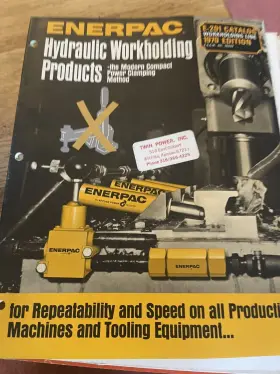
( Brand: Enerpac ), ( Model: ENERPAC E-306 ), ( Publication Year: 1970 ), ( Type: Catalog ), ( Features: Illustrated ), ( Topic: Tools ), ( Modified Item: No ), ( Manufacturer Part Number: E-306 )
Review ENERPAC Hydraulic Worholding Products Catalog Ed
Enerpac E-306 Hydraulic Workholding Catalog (E-201, 1970 Edition)
The Enerpac E-306 Hydraulic Workholding Catalog E-201, published in 1970, is a comprehensive document detailing Enerpac's extensive range of hydraulic workholding solutions. This catalog showcases the company's commitment to providing innovative and reliable industrial tools and equipment designed to enhance productivity and safety in various industries.
The opening pages introduce the reader to key product categories, including hydraulic vices, clamps, cylinders, and power tools. Each category is accompanied by detailed illustrations and product specifications, allowing users to quickly and easily identify the ideal workholding solution for their specific applications.
Hydraulic Vices: The catalog includes an extensive selection of hydraulic vices, exhibiting options with various jaw capacities ranging from 1/2 inch to 56 inches. These versatile vices are designed to accommodate different workpiece materials and geometries, ensuring efficient and precise clamping. Key features include quick-setup jaws, incorporation of precision ground jaws, and heavy-duty construction for long-lasting performance.
Clamps: Enerpac's hydraulic clamp offerings span multiple product lines, such as welding clamps, strap wrenches, and overhead clamps. The catalog illustrates various machined surfaces, jaw styles, and clamping force capabilities, enabling users to choose a product that best suits their specific application demands.
Hydraulic Cylinders: This catalog includes a wide range of hydraulic cylinders, offering custom designs to suit various applications. Key specifications include bore sizes, stroke lengths, rod sizes, and materials of construction. Additionally, options for accessories such as rod end fittings and flexible hoses are highlighted.
Power Tools: Enerpac's power tools catalog showcases an array of hydraulic power hammers along with impact wrenches and drills. These powerful tools, designed for high-torque applications, deliver exceptional performance with minimal effort from the user. Important properties include varying impact energy levels, hammer capacities, and power source compatibility.
Concluding the catalog, readers are presented with valuable information regarding product ordering, contact details for local offices and distributors, and resources for additional product information and technical support. By diligently combining practical descriptions, clear illustrations, and in-depth specifications, this historic catalog celebrates the impressive evolution of hydraulic workholding technology and Enerpac's unwavering commitment to industrial innovation.
A Comparative Analysis of the Enerpac E-306 Hydraulic Workholding Catalog E-201 (1970 Edition)
Introduction:The Enerpac E-306 Hydraulic Workholding Catalog E-201 from 1970 is an essential resource for engineers and technicians dealing with hydraulic workholding solutions. It's important to understand both the advantages and disadvantages of using this catalog in a modern engineering context for effective decision-making.
Advantages:1. Historical Perspective: This catalog provides a comprehensive and detailed view of hydraulic workholding technology from 1970, making it an invaluable resource for understanding the evolution of the technology and design principles.
2. Versatility: With a vast array of hydraulic cylinder sizes, shapes, and configurations listed, the catalog offers numerous application possibilities for various industries like automotive, aerospace, and heavy industries.
3. Reliability: The catalog explains detailed specifications, technical data, and application diagrams for each product, ensuring a high level of confidence in selecting appropriate hydraulic workholding components.
Disadvantages:1. Limited Technology Integration: Since the catalog is from 1970, it may not include contemporary technologies, materials, or design concepts. As a result, some solutions may not be up-to-date with current industrial needs and standards.
2. Adaptation Challenges: As Enerpac's product offerings have evolved, it might be difficult to integrate the older solutions with newer systems or contemporaneous technologies. Interfaces may not be standard, and adjustments may require additional engineering effort.
3. Availability of Spare Parts: Finding spare parts for equipment based on this catalog can be challenging due to the vintage nature, as manufactures may no longer produce them, or their availability might be restricted in the aftermarket.
Conclusion:The Enerpac E-306 Hydraulic Workholding Catalog E-201 (1970 Edition) is a valuable historical resource containing extensive information on hydraulic workholding solutions from an earlier era. While its content may not directly align with modern industrial needs and design standards, its insights offer a rich foundation for understanding the development of hydraulic technology in manufacturing processes. This catalog should be considered as a supplement to contemporary resources rather than a standalone solution.
Recommendation:For contemporary engineering applications, it is recommended to consult more recent Enerpac catalogs or their official website for accurate and up-to-date information on hydraulic workholding components. However, the 1970 catalog can serve as an essential reference for historical context, problem-solving, and understanding the evolution of mechanical design in hydraulic engineering.
Details:
This is a used manual. It may have missing pages/sections.
part #: e306 price
- $25.00
specifications catalogcrave:
- brand: Enerpac
- model#: ENERPAC E-306
- publication year: 1970
- type: Catalog
- features: Illustrated
- topic: Tools
- modified item: No
- manufacturer part number: E-306
shipping catalogcrave:
- transit: 5-12 Days
- carrier: USPS
- cost: $0.00
- class: Standard
- service: USPS Ground Advantage
- type: Calculated
seller catalogcrave:
- city: Chouteau, Oklahoma
- rating: 100.0%
- # reviews: 182
returns catalogcrave:
- policy: No Returns
offer catalogcrave:
- options: Ship-to-home
- best offers: True
- availability: In Stock
- started: January 29, 2025
- quantity: 1
- sold: 0
general catalogcrave:
- Books Magazines > Catalogs
- condition: Good
payments catalogcrave:
- credit card: Diners-club
- wallet: Google-pay
- other

1 offer $25.00 USD
- Good. Offer #1 priced at $25.00 + $0.00 delivery = $25.00* total. It may have missing pages/sections This is a used manual.FREE SHIPPING